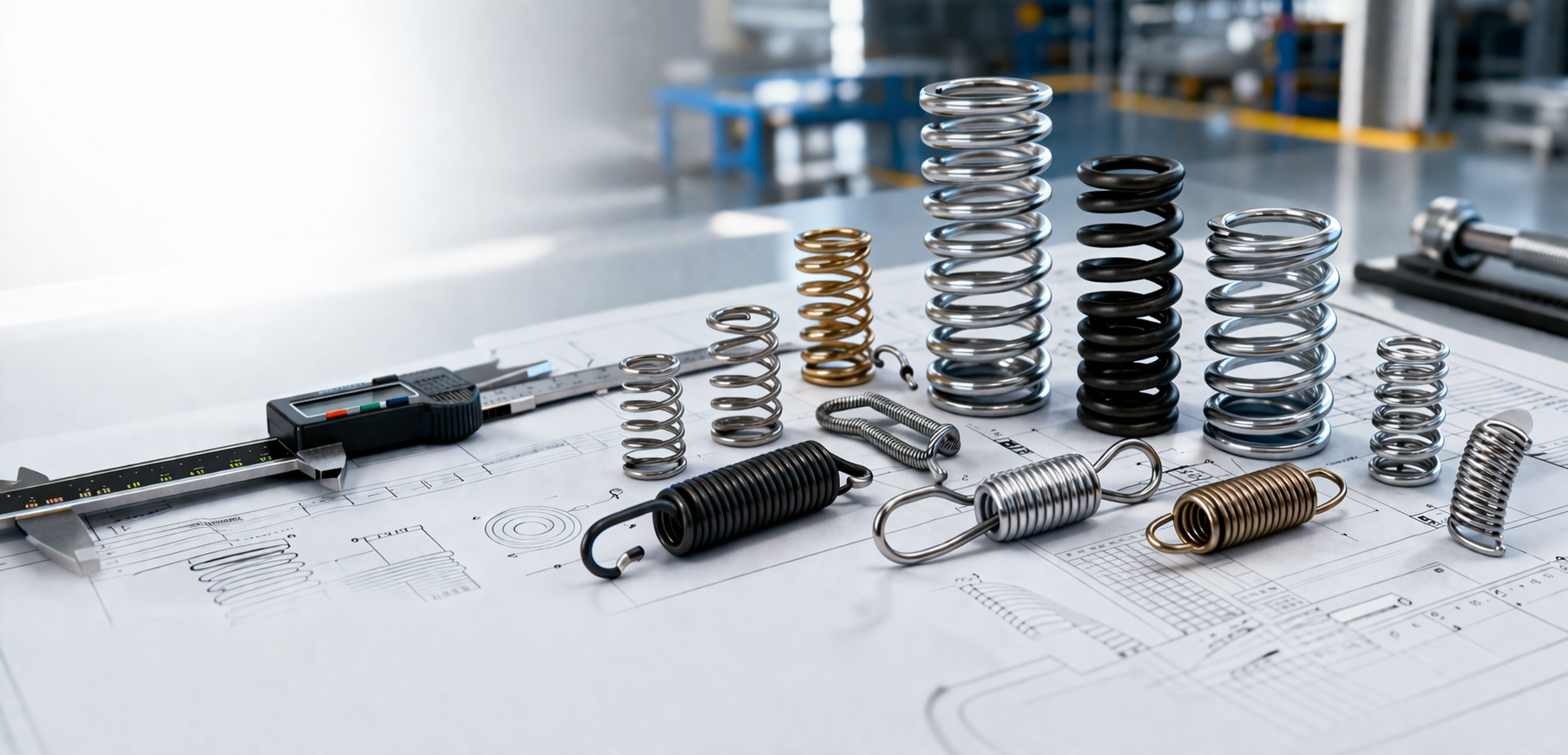
How to Choose the Right Industrial Spring for Your Application (Complete OEM Guide)
Selecting the right industrial spring is not just a design choice—it directly impacts performance, safety, and lifecycle costs. Across decades of manufacturing custom springs, most failures originate from incorrect selection at the design stage rather than production issues. In practice, teams often overlook how real operating conditions differ from lab assumptions. Seasonal temperature shifts, contamination, misalignment, and installation variance all influence performance. Experienced manufacturers account for these through design margins, testing protocols, and material selection. Where possible, validate assumptions with prototypes and field trials before scaling to production. Documenting load cases, duty cycles, and failure history helps refine future designs and reduces lifecycle costs.
Load and Deflection
Every spring is defined by load and deflection. Engineers must specify operating loads, peak loads, and allowable deflection ranges. Designing within 30–70% of maximum capacity improves fatigue life and reliability. In practice, teams often overlook how real operating conditions differ from lab assumptions. Seasonal temperature shifts, contamination, misalignment, and installation variance all influence performance. Experienced manufacturers account for these through design margins, testing protocols, and material selection. Where possible, validate assumptions with prototypes and field trials before scaling to production. Documenting load cases, duty cycles, and failure history helps refine future designs and reduces lifecycle costs
Material Selection
Material choice determines strength, corrosion resistance, and fatigue behavior. Stainless steel is preferred for corrosive environments, while high-carbon steels offer higher strength for heavy-duty applications. In practice, teams often overlook how real operating conditions differ from lab assumptions. Seasonal temperature shifts, contamination, misalignment, and installation variance all influence performance. Experienced manufacturers account for these through design margins, testing protocols, and material selection. Where possible, validate assumptions with prototypes and field trials before scaling to production. Documenting load cases, duty cycles, and failure history helps refine future designs and reduces lifecycle costs.
Environmental Considerations
Temperature, humidity, and chemical exposure significantly affect performance. In fluid systems, corrosion is often the dominant failure mode, making coatings and alloys essential. In practice, teams often overlook how real operating conditions differ from lab assumptions. Seasonal temperature shifts, contamination, misalignment, and installation variance all influence performance. Experienced manufacturers account for these through design margins, testing protocols, and material selection. Where possible, validate assumptions with prototypes and field trials before scaling to production. Documenting load cases, duty cycles, and failure history helps refine future designs and reduces lifecycle costs.
Custom vs Standard
Standard springs may suffice for non-critical uses, but OEM and industrial systems benefit from custom designs that match exact requirements, reducing failure risk and improving performance. In practice, teams often overlook how real operating conditions differ from lab assumptions. Seasonal temperature shifts, contamination, misalignment, and installation variance all influence performance. Experienced manufacturers account for these through design margins, testing protocols, and material selection. Where possible, validate assumptions with prototypes and field trials before scaling to production. Documenting load cases, duty cycles, and failure history helps refine future designs and reduces lifecycle costs.
Conclusion
Spring selection combines engineering precision with real-world understanding. Partnering with an experienced custom spring manufacturer ensures alignment between design, materials, and application conditions. In practice, teams often overlook how real operating conditions differ from lab assumptions. Seasonal temperature shifts, contamination, misalignment, and installation variance all influence performance. Experienced manufacturers account for these through design margins, testing protocols, and material selection. Where possible, validate assumptions with prototypes and field trials before scaling to production. Documenting load cases, duty cycles, and failure history helps refine future designs and reduces lifecycle costs.