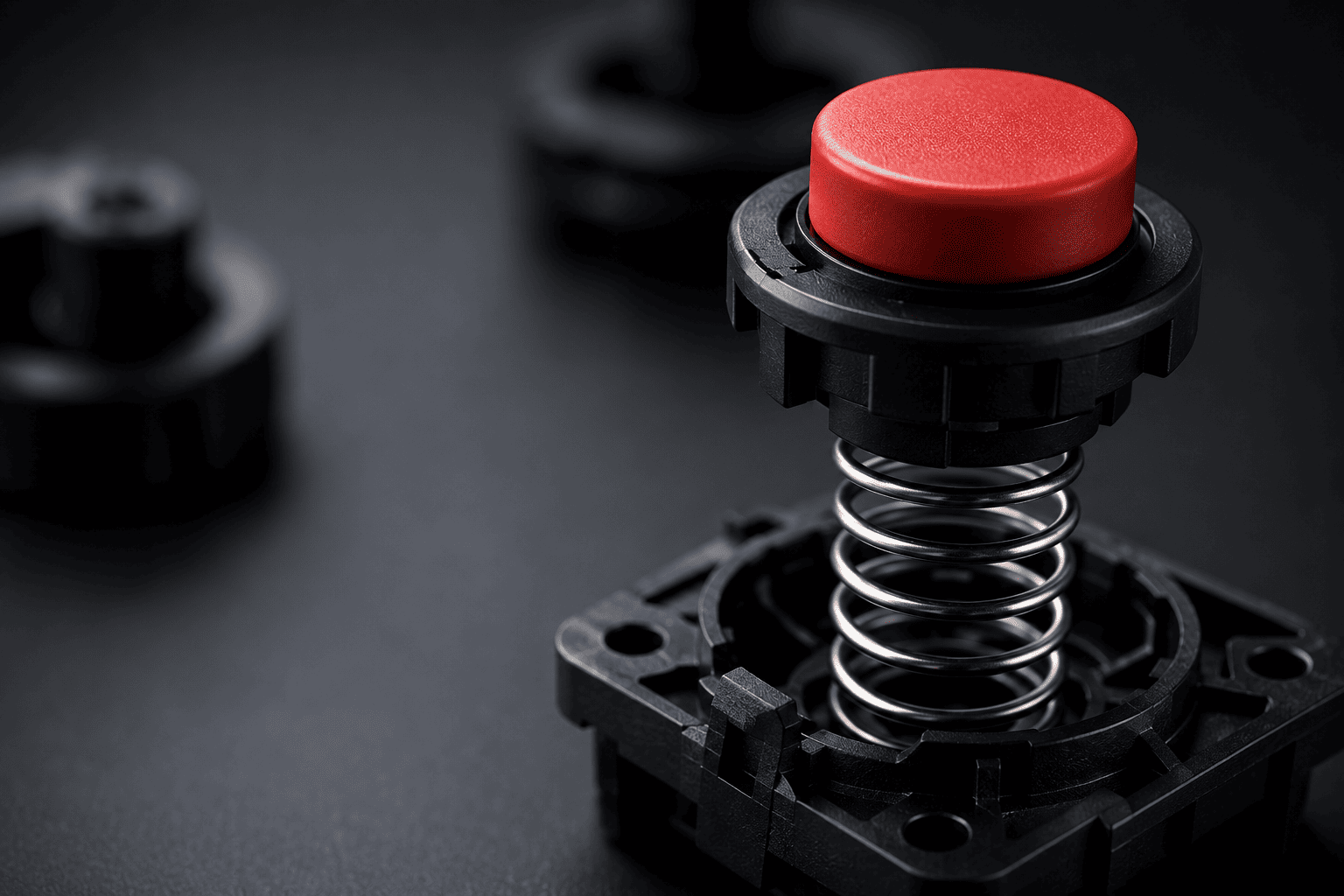
The Button Is Coming Back. And Behind It, So Is the Spring
For a while, it looked like every physical control was going to disappear. Buttons became icons. Knobs became sliders. Switches became menus. In cars, appliances and consumer products, smooth glass surfaces came to represent modern design. If a function could be moved to a touchscreen, it often was. Now, something interesting is happening. Not everywhere, and not because touchscreens are going away. But across automotive interiors, industrial equipment, appliances and other products, manufacturers are reconsidering whether every interaction belongs behind a screen. A temperature control that is adjusted frequently may be easier to operate with a knob. A machine operator wearing gloves may need a switch that can be felt. A driver should not always have to look away from the road to change a basic setting. And when physical controls return, so does an old engineering requirement:
Why Physical Buttons and Controls Are Returning
Touchscreens solved several real problems. They reduced visible clutter. They allowed one surface to control many functions. Software updates could change interfaces without redesigning physical hardware. For products with complex menus and infrequently used settings, this made sense. But a touchscreen also removes something physical controls provide naturally: tactile feedback. With a well-designed button, switch or rotary control, the user can often feel:.
- When the control has moved
- When resistance begins
- When actuation occurs
- When the mechanism returns
- Whether a position has been reached
- Whether an input has registered
The Feel of a Button Is an Engineering Problem
Press two buttons that look identical and they can feel completely different. A physical control may depend on a combination of:
- Spring rate
- Preload
- Return force
- Geometry
- Friction
- Material
- Tolerance
- Cycle life
The Spring Behind the Switch
Consider a simple push button. The user applies force. The button moves through a defined travel. An internal mechanism actuates. The finger is released. The button returns to its original position. That return may depend on a compression spring. The basic principle is simple. The design requirement may not be. If the spring force is too low, the button may feel weak or may not return reliably under all operating conditions. If the spring force is too high, repeated use may become uncomfortable. If the spring rate is poorly matched to the available travel, the force curve may feel wrong. If tolerances vary too much between batches, one unit may feel different from another. The user does not see any of this. They simply press the button and decide, often instantly, whether it feels good.
Why Tactile Feedback Matters
A touchscreen provides visual feedback. It may also provide sound or vibration. A mechanical control provides something more direct: resistance against the hand. That resistance tells the user what is happening. Think about the difference between:
- Turning a rotary selector
- Pressing a machine control
- Operating a rocker switch
- Adjusting a mechanical lever
- Releasing a latch
- Moving a control through defined positions
Why Tactile Feedback Matters
The automotive industry became one of the clearest examples of the move toward touchscreens. Functions that once had dedicated buttons and knobs were increasingly moved into central displays. Climate settings, seat controls, drive functions and other frequently used features could require navigating through digital menus. The result looked clean. But clean is not always convenient. A physical knob can be located by touch. A button can provide immediate mechanical feedback. A switch can be operated without waiting for a menu to load or checking whether the correct area of a screen was touched. This is one reason the conversation around automotive controls is changing. The future is unlikely to be "all buttons" or "all screens." It is more likely to be a combination. Screens for information and complex functions. Physical controls for frequent, immediate or safety-relevant interactions. And that creates renewed engineering attention around the components inside those controls.
Where Springs Are Used in Physical Controls
Srings can perform several different functions within buttons, switches and control mechanisms.
Return Mechanisms
A spring returns a button, lever or actuator to its starting position after the user releases it. Compression springs are commonly considered for applications where a control moves linearly under load..
Rotary Controls
Rotary selectors and knobs may use spring elements as part of return, positioning or detent mechanisms. Depending on the design, torsion springs or custom wire forms may be used.
Rocker Switches
Rocker mechanisms may require spring force to support movement, return or stable positioning. The exact spring design depends on the geometry and switching mechanism.
Levers and Handles
Control levers may use torsion springs to create rotational return force.The leg geometry, torque and angular movement need to match the assembly.
Latches and Release Controls
Springs are frequently used to return or maintain the position of latches, catches and release mechanisms.
Electrical and Electromechanical Controls
Compact electrical products may use small precision springs where dimensional consistency is important because the available space is limited. In many of these applications, a standard spring may not fit the mechanism. That is where a custom spring manufacturer in India becomes relevant.
Small Spring, Large Effect on Product Quality
A customer may never see the spring inside a control. But they can often feel its performance. This creates an interesting situation for product manufacturers. The spring may account for a small portion of the total bill of materials, yet it can influence the perceived quality of the entire product. Consider a control panel with ten identical buttons. If nine buttons return cleanly and one feels slightly weak, the inconsistency is immediately noticeable. Consider a rotary control where resistance varies from unit to unit. Or a lever that becomes slower to return after repeated use. Or a switch that begins to feel loose long before the rest of the product reaches the end of its expected life. These are not merely component issues. They become product-quality issues.
Repeatability Matters More Than the First Sample
When developing a new control mechanism, it is relatively easy to focus on the prototype. Does the button move? Does it return? Does the spring fit? Does the mechanism actuate? But OEM production introduces a harder question: Will every unit behave the same way? A manufacturer may need thousands of springs across multiple production batches. Variation in free length, load, diameter, coil geometry or end configuration can influence how the control feels and performs. For products with several identical controls, consistency becomes even more visible. The challenge is not to manufacture one spring that works. It is to manufacture the spring repeatedly. This is why OEMs looking for a precision spring manufacturer in India should consider production consistency alongside price.
Different Controls Need Different Springs
There is no single “button spring. The correct spring depends on the movement and force required by the mechanism.
Compression Springs for Push Buttons
Compression springs are commonly used where the user presses a control inward and the mechanism must return after release. Applications can include:
- Appliance controls
- Machine controls
- Automotive interior mechanisms
- Electrical products
- Release mechanisms
Torsion Springs for Rotary and Lever Controls
Torsion springs can be used where rotational force is required. Applications may include:
- Levers
- Hinged controls
- Return mechanisms
- Handles
- Selectors
- Mechanical actuators
Extension Springs for Return Functions
Extension springs may be suitable where two components need to be pulled back toward a defined position. They can be used in:
- Mechanical linkages
- Return mechanisms
- Control assemblies
- Latches
- Equipment mechanisms
Custom Wire Forms
Some control mechanisms require a wire component with a specific geometry rather than a conventional helical spring. Custom wire forms can be designed for:
- Retaining
- Positioning
- Locking
- Guiding
- Supporting
- Connecting moving components
Why Custom Spring Design Matters for Controls
Physical controls are often constrained by space. The industrial designer may define the visible button. The mechanical assembly may already have limited room. The electronics may occupy most of the enclosure. The spring must fit into whatever space remains while still delivering the required force and travel. This can create demanding requirements. This is where early collaboration between the OEM and the spring manufacturer can help. The question is not simply, "Can you manufacture this drawing?" Sometimes the more useful question is: "Can this spring be manufactured consistently for the function we need?"
- Smaller without becoming too stiff
- Strong enough to return reliably
- Consistent across repeated cycles
- Resistant to relaxation
- Suitable for the operating environment
- Manufacturable at production volume
The Return of Physical Controls Creates a New Opportunity for Better Engineering
The return of buttons does not mean product design is moving backwards. It may mean designers are becoming more selective. Not every function needs a physical control. Not every function belongs on a touchscreen. The better approach is to choose the interface based on how the product is actually used. For frequently accessed functions, safety-relevant actions, industrial environments and situations where visual attention is limited, physical controls can offer clear advantages. But bringing back the button also brings back responsibility for mechanical quality. A poorly designed physical control is not better than a touchscreen simply because it moves. It must feel deliberate. It must return consistently. It must survive repeated use. It must behave the same way across production units. And somewhere inside that mechanism, a spring is often doing more work than anyone notices.
Sriram Industries: Custom Springs for Switches, Controls and OEM Applications
Sriram Industries manufactures custom springs and wire forms in India for OEM and industrial requirements. For manufacturers developing switches, control mechanisms, return systems, electrical components, automotive assemblies, consumer products or industrial equipment, the spring requirement often begins with the application rather than a standard catalogue size. Sriram Industries works with customer drawings, samples and application requirements to support custom spring manufacturing. Applications can require different types of spring solutions depending on movement, load, available space and operating conditions, including:
- •Compression springs
- Extension springs
- Torsion springs
- Custom wire forms
Looking for a Spring Manufacturer in India for a Control or Switch Application?
If you are developing a physical control, button, switch, lever, latch or return mechanism, the spring is worth considering early in the design process. Sriram Industries manufactures custom springs and wire forms for OEM and industrial applications in India. Because when the button comes back, the spring behind it matters too.
- Available installation space
- Required force
- Working travel
- Operating environment
- Expected number of cycles
- Material preference
- Annual quantity